Important: self-enumeration for Phase II of Census 2027 is OPEN NOW in Uttar Pradesh, Punjab, Goa and the non-snow-bound parts of Uttarakhand — you can fill your household's details online till 30 November 2026. Everywhere else in India, the window opens on 10 January 2027. The only official portal is se.census.gov.in. No fee. No documents to upload. Just a mobile number and an OTP.
1. What is Census 2027 self-enumeration, in plain words
Census 2027 is India's 16th census. The 8th since Independence. And the first one that's fully digital.
Here's what's different this time. You don't have to sit around waiting for the enumerator to knock on your door. You can fill in your household's census details yourself — online, from your own home, in your own time.
That's all self-enumeration is. The government has put up a web portal, se.census.gov.in, where the head of the household — or any responsible adult in the family — can type in the household's details and answer the census questions. About 45 minutes for a five-member household, the portal's own guide says — quicker if your family is smaller. And when you're done, the portal hands you a unique Self-Enumeration ID. Your SE ID. Keep it somewhere safe. When the enumerator comes visiting later, you show them that ID — and you're done.
One thing, right at the start, because people get this wrong: self-enumeration is optional. Not compulsory. If you never touch the online form, nothing bad happens to you. The enumerator will still come to your house and write everything down door to door, exactly the way every census before this one worked. The online option is just there to save time. Yours, and theirs.
2. Is self-enumeration open right now?
Is it open right now? Depends entirely on where you live. The census doesn't open everywhere on the same day — it never has. Here's the picture — it depends on the window for your state:
All other States and Union Territories (except Manipur, Ladakh and snow-bound areas)
10 – 24 January 2027
Opens 10 January 2027
Ladakh and snow-bound areas of Jammu & Kashmir, Himachal Pradesh and Uttarakhand
17 – 31 August 2026
Already done (Phase II held in September 2026)
Manipur
—
On hold till further orders
So — Uttar Pradesh, Punjab, Goa, the plains of Uttarakhand? Don't put it off. The window runs 16–30 November 2026, and it closes on 30 November. The portal flashes the last date as a running notice on every single page, and here's the catch: if you don't finally submit before the closing date, your self-enumeration doesn't count as complete. Half-filled doesn't count.
3. The dates that matter
Quick background, because the dates only make sense with it. Phase I — the Houselisting and Housing Census, the one that asked about your house, what facilities it has, what your household owns — ran from April to September 2026. It's finished now in 35 States and Union Territories. Manipur is the exception.
Phase II is the Population Enumeration. This is the part where every single person gets counted, with details — name, age, sex, marital status, caste, religion, education, language, disability, migration, occupation. And for married women, fertility particulars too. Caste is being counted in this phase as well — the Cabinet Committee on Political Affairs decided that on 30 April 2025.
What
UP, Punjab, Goa, non-snow-bound Uttarakhand
Rest of India
Self-enumeration
16 – 30 November 2026
10 – 24 January 2027
House-to-house enumeration
1 December 2026 – 4 January 2027
25 January – 28 February 2027
Revisional round
5 – 9 January 2027
1 – 5 March 2027
Reference date
00:00 hours, 5 January 2027
00:00 hours, 1 March 2027
That "reference date" — what is it, really? It's the moment the census freezes time. Everybody is counted as they were at that midnight, no matter what changes afterwards. Ladakh and the snow-bound areas had a different one, 1 October 2026, because their enumeration happened back in September.
4. What you need before you start
The good news first. You don't have to upload a single document. No Aadhaar. No ration card. No photo. Getting in takes very little — but keep these ready before you sit down:
Your mobile number — preferably the same one that was given during Phase I, the houselisting. The portal works with any mobile number, but using the Phase I number makes matching your household much smoother.
The head of the household's name. Type it carefully. Once registered, this name cannot be changed on the portal. So no nicknames, no short forms — the name as it should appear.
An email ID (optional). If you give one, your SE ID comes to you by email as well. Worth doing, honestly.
Your address details — district, village or town, locality or a nearby landmark, and the PIN code if you know it.
A phone or a computer with internet. A laptop or desktop is easier, because one step asks you to mark your house on a digital map. A phone works too — just take your time with the map, don't rush that screen.
One mobile number, one household. That's the rule. You can't use the same number for two different households — so no, you can't fill in your neighbour's family form with your own number.
5. How to fill the Census self-enumeration form — step by step
Here it is, then — the whole process, step by step, exactly the way the official portal lays it out:
Open the official portal. Go to se.census.gov.in in your browser. Check the address yourself, letter by letter — this is the only official website. Any other link, SMS or WhatsApp forward claiming to be the census form is fake. Full stop.
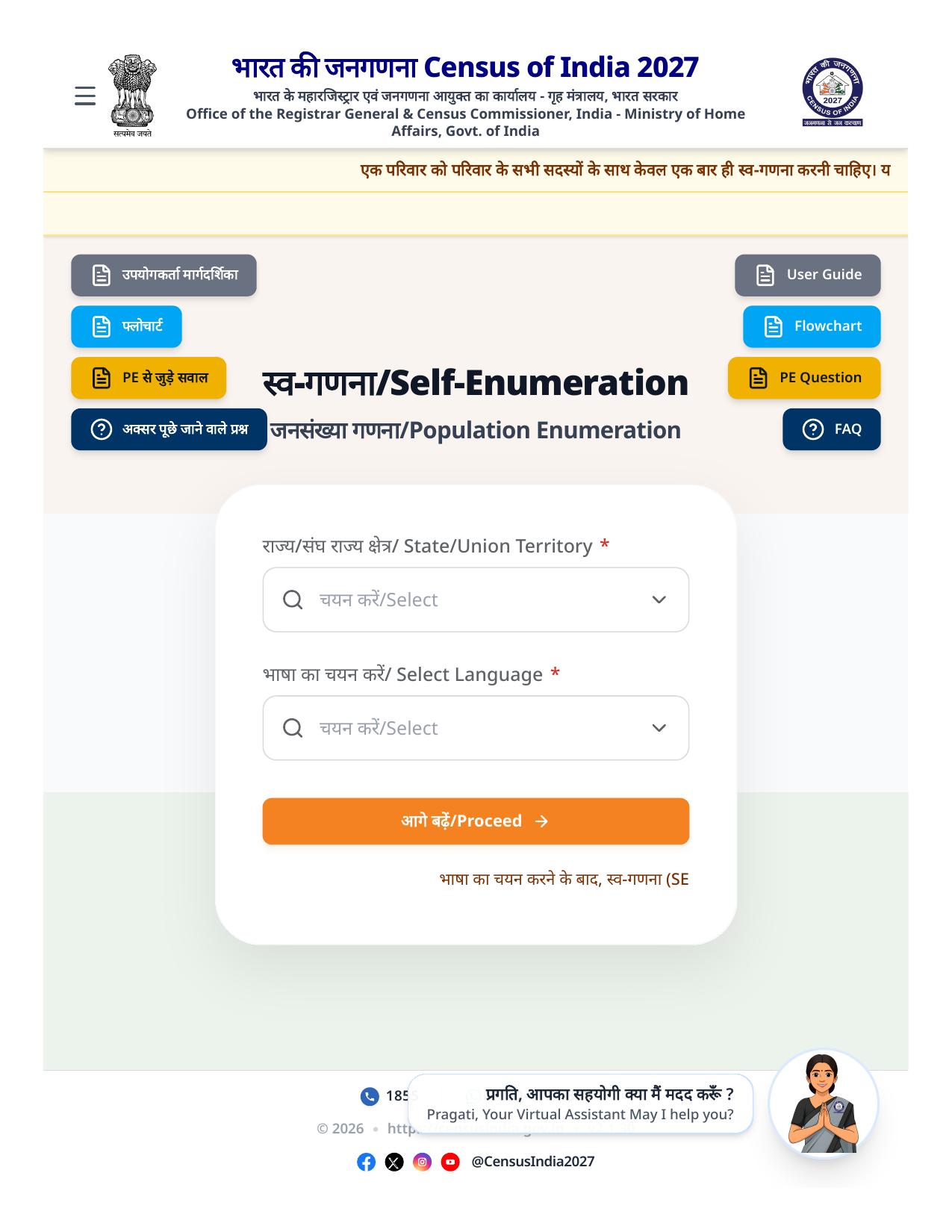
Select your State or Union Territory and complete the captcha on the screen.
Enter the head of the household's name, your mobile number, and your email ID if you have one.
Verify with the OTP. A one-time password comes to your mobile — and to your email too, if you gave one. Type it in to continue.
Choose your language. The portal works in English and 15 other Indian languages. Pick the one you're most comfortable reading — and remember, once you pick it, you cannot change it later. So don't tap the first option in a hurry.
Fill in the details. This is the main part, so take it slow. You'll answer 40 notified questions covering your household and every person in it — housing details from Phase I carry over, and Phase II asks about each member: name, age, sex, relationship to the head, marital status, caste, religion, education, mother tongue and other languages, disability, migration, and occupation. Answer slowly. A wrong age or a misspelt name now means the enumerator has to fix it later — and that's a headache for everyone.
Mark your house on the map when the portal asks for your location. Zoom in, find your street, and drop the pin on your house. If the pin lands two lanes away, drag it to the right roof.
Review everything, then submit. Read the summary screen once, properly, before you press submit. After submission you get your unique Self-Enumeration ID (SE ID) on the screen, and by SMS and email. Write it down, take a screenshot, save the SMS — whatever works for you. When the enumerator visits, share this ID with them. That's what completes your household's census.
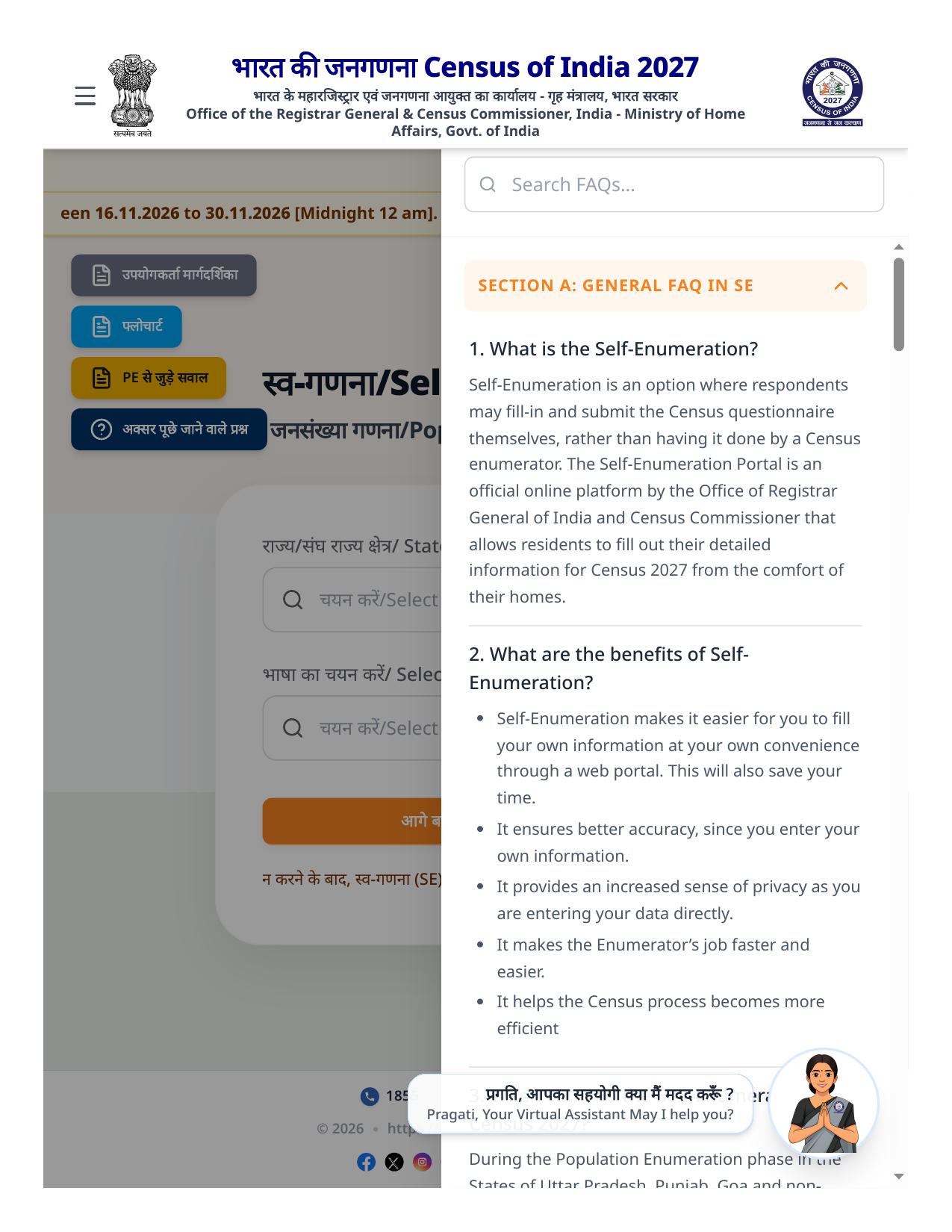
The portal's home page, se.census.gov.in — pick your State, pick your language, hit Proceed. That orange button is where it all starts.Stuck somewhere? The FAQ button on the portal opens this panel — the first question it answers is the obvious one: what is self-enumeration, anyway?
6. What happens after you submit
Submitting the form isn't the end of it. The enumerator is still going to visit your home during the house-to-house round. In UP, Punjab, Goa and Uttarakhand that's 1 December 2026 to 4 January 2027. Everywhere else, 25 January to 28 February 2027. When they turn up, hand over your SE ID. They check your details against what you submitted — and that's the loop closed.
Never self-enumerated? No problem at all. The enumerator just covers your household in full on the visit. One way or the other, you get counted.
7. Mistakes people make — avoid these
Waiting till the last evening. The portal closes on the last date — in the four open states, that's 30 November 2026. And when everyone rushes in at once, servers slow down and OTPs get delayed. Don't be that person refreshing the page at 11 at night.
Using a different mobile number from Phase I. It works, technically. But matching takes longer and can create confusion. If you still have the registered number, use that one.
Typing the head of household's name wrong. It cannot be changed later. Check the spelling before you move on — one extra minute here saves a correction later.
Picking a language in a hurry. The language you select at the start is locked in. Choose the one you can actually read properly, not the one that looks familiar.
Forgetting the SE ID. The whole point of self-enumerating is that ID. Screenshot it, write it on paper, keep the SMS. Lose it, and the enumerator will have to record your details all over again — which defeats the purpose.
Trusting fake links. The census never asks for money, bank details, or OTPs over a phone call. The only website is se.census.gov.in. If someone calls asking for your OTP in the name of the census, it's a fraud. Hang up.
8. Is it compulsory? Is my data safe?
Two questions come up in every conversation about this. First one: is it compulsory?
The census itself — yes. Under the Census Act, 1948, every household has to be counted, no exceptions. But self-enumeration? That's not compulsory. It's an extra facility, that's all. Skip it and the enumerator counts you anyway.
Second question: my data — is it safe?
Everything collected under the Census Act, 1948 is strictly confidential. It's used only for statistics and development planning — nothing else. Individual details are never shared, never published in a way that could identify anyone. The government has said so in every official release. And frankly, it's the law.
9. Official links — only these
Self-enumeration portal: https://se.census.gov.in
Census of India (Registrar General): https://censusindia.gov.in
PIB release, 16 November 2026: Self-Enumeration for Phase II commenced in Goa, Punjab, Uttar Pradesh and non-snow-bound Uttarakhand.
Want the official papers themselves? The portal's own documents are here — download them straight from our site:
Household Schedule (official, PDF):Household Schedule for Self-Enumeration — all the questions the portal will ask, so you can keep the answers ready before you start.
Census 2027 is the biggest headcount India has ever tried. The world's largest census, actually — and the first one run entirely on digital tools. The approved outlay is about ₹11,718 crore. It was supposed to happen in 2021. Covid pushed it back. Sixteen years after the last census, the country finally gets a fresh picture of itself. Your part takes under an hour. Do it before the window closes.
10. All 40 questions the form will ask — keep the answers ready
The portal asks 40 notified questions. Nothing more, nothing hidden. Here they are, grouped — go through them once with the family before you sit down, so you're not hunting for answers mid-form. The official Household Schedule (all 40 questions, exactly as notified) is linked in section 9.
Who you are (questions 1–6): name of every person, starting with the head of the household; relationship to the head; sex; date of birth and age; current marital status; age at marriage.
Family background (7–13): spouse's name; nationality; religion; whether SC, ST or another caste — you can also choose "does not want to declare caste" or "no caste"; father's details — name, date of birth, place of birth, religion; mother's details — the same; disability, if any (up to three types can be selected).
Language and education (14–17): mother tongue, plus two other languages you know, in order of how well you know them; whether you can read and write, and whether you are digitally literate (for age 7 and above); whether you are attending school, college or any other institution; your highest education level, and your stream or subject if you studied Class 11 or above.
Work (18–25): whether you worked at any time in the last year — main worker, marginal worker, semi-marginal worker or non-worker; what kind of work — cultivator, agricultural labourer, household industry or other work; your occupation and the nature of the industry, trade or service; whether employer, employee, single worker or family worker; if you didn't work — student, household duties, dependent, pensioner or other; whether you are seeking work; and how far you travel to work, how long it takes, and how you get there.
Migration (26–30): place of birth; place of last residence and whether it was rural or urban; reason for moving; how long you have lived here; and your permanent residential address.
For married women (31–33): number of children surviving at present, number of children ever born alive, and — for currently married women — children born alive in the last one year.
Other details (34–40): where you got the Covid-19 vaccination; how many bank accounts you have; your mobile number; Aadhaar number; Voter ID number; passport number; and whether you hold a driving licence. All of these are "if available" — you can answer No. Nothing is uploaded, and no document is asked for.
That's the lot. No question about income, no question about property, no bank account number — just the count of accounts. If a form floating around on WhatsApp asks for anything more, it isn't the census.
11. Problems people run into — and what to do about them
OTP doesn't arrive. Wait a minute or two — OTPs slow down when lakhs of people log in together, especially in the last days. Don't keep hammering the resend button; it doesn't help. And honestly, don't leave this for the last evening.
The portal is slow. Same reason — everyone rushes in at the end. Try early in the morning. The portal runs from 6 in the morning till midnight, so the early hours are the quietest. A laptop or desktop also handles the map step better than a phone.
"Mobile number mismatch." This pop-up means the number you typed doesn't match the one given during Phase I. Two options: try another mobile number from your household, or press Proceed with this one. If you proceed, the portal will ask you to mark your house on the map so your form reaches the right enumeration block.
The map pin lands on the wrong house. Drag it to the right roof. On a phone, use two fingers to zoom in and move the map. The box showing latitude and longitude tells you exactly where the pin sits — check it before you press confirm.
You picked the wrong language. You can't change it afterwards — the portal locks the language at the start. It isn't the end of the world: the enumerator can sort out the answers when they visit. Just be careful at that step next time.
You forgot the SE ID. The portal lets you get it back later with your registered mobile number. Still — screenshot it the moment it appears, note it on paper, and tell everyone in the house.
You can't edit after submitting. True — once you press Submit, the portal locks the form. But the enumerator can update your answers during the house visit, with your consent. So a mistake isn't permanent; it just waits for the visit.
Half-finished doesn't count. You can log out in the middle — finished sections stay saved, and you can pick up where you left off. But if you never press the final submit before the closing date, the self-enumeration doesn't count as complete.
One household, once, at home. Self-enumeration is done only where the household normally lives — even if the family has houses in two places, pick the one where it normally resides. And one household self-enumerates only once. Don't submit twice.
12. What happens next — the full timeline after you submit
The SE ID is 11 digits long, starting with the letter P. It appears on your screen the moment you submit, and it also comes by SMS to your registered mobile number — and by email, if you gave one. Screenshot it, write it down, and tell every member of the household. Whoever happens to be home when the enumerator arrives needs to be able to give it.
Then comes the enumerator's visit. In UP, Punjab, Goa and non-snow-bound Uttarakhand, house-to-house enumeration runs 1 December 2026 to 4 January 2027. Everywhere else, 25 January to 28 February 2027. They will match your SE ID against the IDs on their mobile; if it doesn't match there, they check it online against the state database. If it matches, your data is confirmed, accepted and submitted — with your signature and the enumerator's. If it doesn't match, they simply collect your household's details afresh. Either way, you get counted.
They can also fix things. If something in your online form was wrong, the enumerator can update it during the visit — with your consent.
After the visits, a revisional round sweeps up anything left — 5 to 9 January 2027 in the four states, 1 to 5 March 2027 everywhere else. The reference date — the midnight everything is frozen at — is 00:00 on 5 January 2027 for the four states, and 00:00 on 1 March 2027 for the rest of India.
And then? The counting is done; the processing takes months. There is no instant result to wait for. The point of the exercise is the count itself — and your part in it is finished the day the enumerator signs off your form.
13. Need help? Helpline, WhatsApp and the portal's own helpers
Toll-free helpline 1855 — launched for this exercise.
WhatsApp 1800-180-1855 — the same help, on WhatsApp.
On the portal itself: a virtual assistant called 'Pragati', a chatbot, short tutorial videos, tooltips next to the questions, and an FAQ panel. The flowchart and the user guide (linked in section 9) walk through the whole process step by step.
One warning, and it matters: the census never asks for money, bank details or OTPs on a phone call. If someone rings up asking for your OTP "for the census", hang up. That's a fraud, not the census.
Frequently asked questions
Q. I live in Bihar. Can I fill the form now? No. Bihar, like all states other than UP, Punjab, Goa and non-snow-bound Uttarakhand, opens on 10 January 2027 — and the window runs till 24 January 2027.
Q. Do I need Aadhaar or any document? No. The portal only needs your mobile number, the head of household's name, and an OTP. No document is uploaded anywhere in the process. Not one.
Q. I filled the form. Will the enumerator still come? Yes. Share your SE ID with them when they visit, and your household's census is complete. That's the whole point of the ID.
Q. What if I make a mistake in the form? Review the summary screen carefully before submitting — that's your one chance to catch it. After submission, corrections are handled when the enumerator visits and verifies your details.
Q. Is there any fee? No. Self-enumeration is completely free. Anyone asking for payment in the name of the census is a fraud.
Q. I forgot my SE ID. What now? The portal lets you get it back later using your registered mobile number. That's also why the guide keeps saying: screenshot it the moment it appears.
Q. The portal says my mobile number doesn't match the Phase I number. What do I do? Either try another mobile number from your household, or press Proceed with this one. If you proceed, the portal will ask you to mark your house on the map so your form reaches the right enumeration block.

 Admin

Comments (0)
Share your question or experience about this syllabus. Your comment will appear after review.
No comments yet — be the first to share your thoughts!